By ATS Staff - October 26th, 2026
Computer Languages Rust Software Development Web Server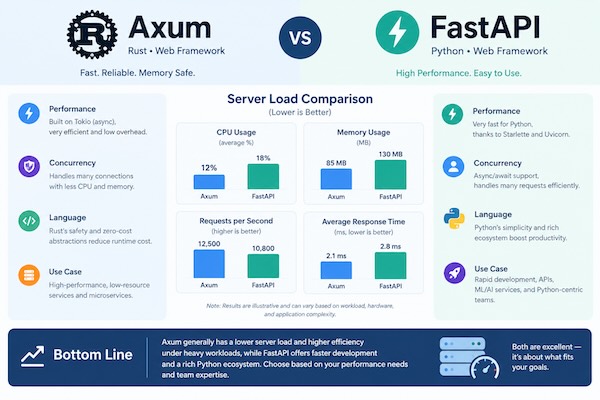
Choosing a backend framework is not just about how quickly developers can build APIs. It also affects server load, memory consumption, response times, scalability, and hosting costs. Two popular options are Axum, a Rust web framework, and FastAPI, a Python framework designed for building modern APIs. Both support asynchronous request handling, but they approach performance differently. For developers building REST APIs, SaaS platforms, database-driven applications, and AI-powered services, understanding these differences can help determine which framework delivers the best balance between performance and development speed.
1. What Are Axum and FastAPI?
Axum: A high-performance Rust framework
Axum is a web application framework built for Rust. It uses the Tokio asynchronous runtime and integrates with the Tower middleware ecosystem. Its key characteristics include:- High request throughput and low response latency.
- Efficient memory management without a garbage collector.
- Strong compile-time type checking and memory safety.
- Asynchronous handling of network and database operations.
- Native executable deployment without requiring a Python runtime.
FastAPI: A productive Python framework
FastAPI is a modern Python framework built around asynchronous programming, type hints, and automatic API documentation. It commonly runs on ASGI servers such as Uvicorn. Its main advantages include:- Rapid API development with concise Python code.
- Automatic OpenAPI documentation and interactive API testing.
- Convenient request validation and serialization.
- Integration with Python's extensive AI, machine learning, and data-processing ecosystem.
- Support for both asynchronous and synchronous endpoints.
2. Server Load: Axum vs. FastAPI
Server load depends on several factors, including CPU usage, RAM consumption, request concurrency, database activity, and application logic.| Performance factor | Axum (Rust) | FastAPI (Python) |
|---|---|---|
| CPU efficiency | Generally excellent | Depends on workload and Python processing |
| Memory consumption | Typically lower | Typically higher |
| Request throughput | Often higher | Usually lower in CPU-heavy benchmarks |
| Response latency | Often lower | More framework and runtime overhead |
| Concurrent I/O | Efficient async execution | Efficient when async code is used correctly |
| CPU-intensive tasks | Well suited | Often benefits from native extensions or separate workers |
| Development speed | More implementation effort | Usually faster |
| AI and ML integration | Possible through services and libraries | Excellent Python ecosystem |
3. Benchmark Results: How Much Faster Is Axum?
Public benchmarks generally show Axum ahead of FastAPI in lightweight HTTP processing. However, results vary substantially depending on hardware, endpoint complexity, concurrency, and test methodology. For example, a published comparison of Axum and FastAPI using a PostgreSQL-backed service reported the following results:| Metric | FastAPI | Axum |
|---|---|---|
| Requests per second | 612 | 15,363 |
| Median latency | 15.4 ms | 0.6 ms |
| Peak memory usage | 78 MiB | 11 MiB |
4. Memory Consumption and RAM Requirements
Memory efficiency matters when running several backend applications on one VPS or dedicated server. FastAPI commonly runs through Python and Uvicorn. If multiple worker processes are configured, each worker may consume its own Python runtime and application memory. Additional libraries, database pools, and caches increase the total footprint. Axum compiles into a native executable and typically uses less memory for a comparable lightweight service. Its actual footprint still depends on dependencies, buffers, connection pools, and workload. Consider a server with 4 GB of RAM running Nginx, a database, PHP applications, and backend APIs. The available memory must be shared among all these services. An Axum service may leave more RAM available for:- MySQL or PostgreSQL database caches.
- PHP-FPM workers.
- Additional APIs and background jobs.
- Operating-system file caches.
- Monitoring and security services.
5. CPU Usage and Server Load Average
CPU usage and Linux load average are related, but they are not the same measurement. CPU usage measures how much processing capacity a process consumes. Load average represents the average number of tasks running or waiting for CPU time, along with certain tasks waiting in uninterruptible states. Axum's lower per-request overhead can reduce CPU consumption when an application processes many requests. That can help the server handle more traffic before CPU saturation. FastAPI may use more CPU for Python execution, request validation, serialization, and other per-request work. However, a well-designed asynchronous FastAPI application can handle large numbers of concurrent network operations without creating a thread for every request. Neither framework automatically fixes a high load average caused by disk I/O, memory pressure, database contention, or other processes. For a production server, monitor:- CPU utilization and per-process CPU usage.
- Load average relative to the number of CPU cores.
- RAM usage, swap activity, and out-of-memory events.
- Request throughput and p95/p99 response latency.
- Database connection counts and slow queries.
6. Asynchronous Programming: Why It Matters
Both frameworks support asynchronous programming, which is especially useful for applications that spend time waiting for databases, remote APIs, or other network services. In FastAPI, an asynchronous endpoint can yield control while waiting for supported asynchronous I/O operations. This allows the event loop to serve other requests in the meantime. Axum uses Rust's async programming model and Tokio runtime to achieve a similar goal. The difference becomes more noticeable when processing CPU-intensive work. Python's Global Interpreter Lock (GIL) limits parallel execution of Python bytecode within a conventional interpreter process. Multiple worker processes or native libraries can help, but they introduce their own resource considerations. Rust does not have the same GIL limitation, and CPU-intensive work can be parallelized using appropriate Rust code and concurrency primitives. Important: Declaring a FastAPI route withasync def does not automatically make blocking code asynchronous. A synchronous database driver, blocking HTTP request, or expensive computation can still stall an event loop.
7. Database-Driven Applications
Many backend applications spend more time interacting with a database than processing HTTP requests. Both frameworks can work with PostgreSQL and MySQL, but the database drivers, query patterns, and connection pools are critical.Axum with PostgreSQL or MySQL
Common choices include SQLx for PostgreSQL and MySQL, or other Rust database libraries. With asynchronous database operations and appropriately sized connection pools, Axum can handle substantial concurrent workloads. Rust's type system and compile-time checks can also help catch certain errors before deployment, depending on the libraries and techniques used.FastAPI with PostgreSQL or MySQL
FastAPI supports several database integration options, including SQLAlchemy and asynchronous drivers such as asyncpg for PostgreSQL and asyncmy for MySQL. FastAPI can perform well when database calls are asynchronous, queries are optimized, and connection pools are sized appropriately. For either framework, an oversized connection pool can overload the database. A slow query can dominate response time even if the framework itself is extremely fast. For CRUD applications, the most useful benchmark is often a realistic database-backed endpoint rather than a simple "Hello World" response.8. Which Framework Is Better for AI Applications?
FastAPI has a significant practical advantage when building applications around Python-based artificial intelligence. Its ecosystem includes tools for:- Machine learning and data science.
- Natural language processing and embeddings.
- Large language model integrations.
- AI agents and retrieval-augmented generation.
- Model inference and data processing.
- Axum for high-throughput API gateways, authentication, routing, and performance-sensitive services.
- FastAPI for AI inference orchestration, Python libraries, data science, and machine learning workflows.
9. Deployment and Hosting Costs
Axum's resource efficiency can reduce infrastructure requirements when the application is CPU-bound or serves many lightweight requests. Potential benefits include fewer resources per API instance, higher request capacity per server, and lower scaling requirements. FastAPI can still be more economical overall when its faster development cycle reduces engineering costs or when the application depends heavily on Python libraries that would be difficult to reproduce in Rust. Hosting costs are influenced by more than framework performance:- Number of application instances.
- Database and cache requirements.
- Traffic patterns and peak concurrency.
- Background jobs and scheduled tasks.
- Observability, security, and deployment complexity.
- Development and maintenance time.
10. How to Choose for a Production Server
Use Axum when:- You need maximum throughput from limited CPU resources.
- Memory consumption is a major constraint.
- Your service handles many requests or connections.
- You are building infrastructure, API gateways, or performance-sensitive microservices.
- Your team is comfortable with Rust's ownership model and compile-time checks.
- You want to build and iterate on APIs quickly.
- Your application depends on Python AI or machine learning libraries.
- Automatic API documentation and validation are valuable.
- Your workload is primarily I/O-bound and FastAPI already meets your performance requirements.
- Your team has stronger Python expertise.
11. How to Benchmark Both Frameworks Fairly
A reliable comparison should use the same server, hardware limits, database, API behavior, payload sizes, and test duration. A practical testing process is:- Implement identical endpoints in Axum and FastAPI.
- Use the same database schema, indexes, and representative data.
- Configure equivalent database connection pools.
- Test simple responses, JSON serialization, database reads, and database writes separately.
- Increase concurrent requests gradually until latency or error rates become unacceptable.
- Record throughput, p50/p95/p99 latency, CPU usage, peak RAM, and error rates.
- Repeat tests and compare results at the same target request rate.
top, pidstat, and vmstat can help monitor server resources.
Avoid relying solely on maximum requests per second. A framework that handles more requests but produces unacceptable tail latency or database contention may not be the better production choice.
Conclusion
Axum and FastAPI are both capable backend frameworks, but they serve somewhat different priorities. Axum is generally the stronger choice for minimizing server resource consumption and maximizing raw API performance. Rust's execution model and memory efficiency make it especially attractive for high-throughput services and resource-constrained servers. FastAPI is generally the stronger choice for rapid development and Python-based AI applications. It can handle significant production workloads when asynchronous I/O, database access, and worker configuration are implemented correctly. For small and medium applications, optimizing database queries, caching, and deployment settings may matter more than changing frameworks. For heavily loaded APIs or services operating close to their resource limits, Axum is worth benchmarking as a potential alternative. The best decision is the one supported by measurements from your real workload—not benchmark numbers alone.Popular Categories
Agile 2 Android 2 Artificial Intelligence 52 Backup Tools 2 Blockchain 2 Cloud Storage 5 Code Editors 2 Computer Languages 13 Cybersecurity 9 Data Science 19 Database 10 Digital Marketing 3 Ecommerce 4 Email Server 2 Finance 3 Google 6 HTML-CSS 2 Industries 6 Infrastructure 4 iOS 3 IoT 1 Javascript 6 Latest Technologies 45 Linux 10 LLMs 11 Machine Learning 32 Maths & Stats 1 Mobile 3 MySQL 3 Open source 1 Operating Systems 7 PHP 2 Postgres 1 Project Management 3 Python Programming 28 Rust 1 SEO - AEO 5 Software Development 50 Software Testing 4 Web Server 8 Work Ethics 2