By ATS Staff - April 28th, 2026
Linux Operating Systems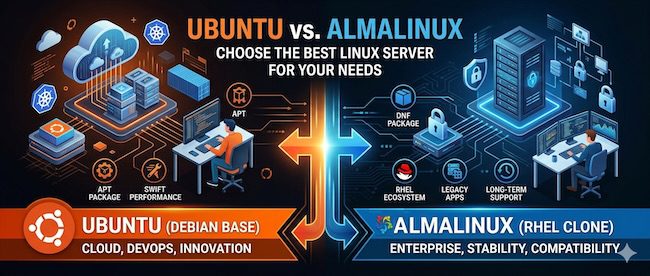
Choosing between Ubuntu and AlmaLinux is a foundational decision for any server deployment. While both are free, open-source, and highly capable, they originate from different lineages and cater to distinct operational philosophies.
Core Philosophies
Ubuntu: The Accessible All-Rounder
Developed by Canonical, Ubuntu is based on the Debian architecture. It is designed to be user-friendly, flexible, and developer-centric. It is the dominant choice for cloud computing, containerized applications (like Docker and Kubernetes), and development workstations. Ubuntu prioritizes ease of access, offering a massive repository of software and extensive community documentation that makes it ideal for beginners and teams moving quickly.
AlmaLinux: The Enterprise Standard
AlmaLinux is a "bug-for-bug" binary-compatible clone of Red Hat Enterprise Linux (RHEL). It was created to fill the void left by the discontinuation of CentOS. Because it tracks RHEL so closely, it is the standard choice for enterprise environments, particularly those running mission-critical commercial software or legacy applications that require strict RHEL certification. It prioritizes long-term stability and predictability over rapid feature updates.
Technical Comparison Table
| Feature | Ubuntu (LTS) | AlmaLinux |
|---|---|---|
| Upstream Base | Debian | RHEL |
| Package Format | .deb | .rpm |
| Package Manager | apt | dnf |
| Support Cycle | 5 years (standard) | Up to 10 years |
| Security Mechanism | AppArmor | SELinux |
| Best For | Cloud, Dev, Containers | Enterprise, cPanel, Legacy |
Key Differences
1. Package Management & Ecosystem
The most immediate difference is how they handle software. Ubuntu uses the APT package manager with .deb packages, which generally favors faster access to newer software versions. AlmaLinux uses the DNF package manager with .rpm packages, which is the industry standard for enterprise servers. If you are managing servers that rely on vendor-specific software (e.g., certain databases or backup agents), you will often find that the documentation and packages are optimized for the RHEL/AlmaLinux ecosystem.
2. Security Defaults
Security is handled differently at the kernel level. Ubuntu uses AppArmor, which is generally considered easier to manage and configure for application-level security. AlmaLinux uses SELinux (Security-Enhanced Linux). While SELinux is more complex to master, it offers much stricter, mandatory access control, making it a favorite for highly regulated, security-sensitive environments.
3. Stability vs. Velocity
- Ubuntu is often chosen for "velocity." Because it is widely used in cloud environments, it is usually the first to support modern deployment tools and newer kernel versions.
- AlmaLinux is chosen for "stability." Its conservative update cycle and long-term support windows (up to 10 years) mean that once a server is configured, it is designed to remain virtually unchanged for years. This drastically reduces the risk of unexpected issues during updates.
When to Choose Which?
Choose Ubuntu If:
- You are building a modern, cloud-native application using Docker or Kubernetes.
- You prioritize ease of use, abundant community tutorials, and a friendly learning curve.
- You want the latest versions of languages like Python, PHP, or Node.js without jumping through hoops.
- You are setting up a development or testing environment.
Choose AlmaLinux If:
- You are hosting a production enterprise environment with mission-critical applications.
- You are using management software like cPanel/WHM (which is natively optimized for the RHEL-based ecosystem).
- Your internal compliance policies mandate RHEL compatibility or strict security standards like SELinux.
- You want a "set it and forget it" server that will remain stable for 5–10 years.
Ultimately, your choice should be guided by your existing team's expertise and the specific software stack you intend to run. If your team is already proficient in one ecosystem (APT vs. DNF), that operational familiarity often outweighs the minor performance or feature differences between the two.
Popular Categories
Agile 2 Android 2 Artificial Intelligence 52 Backup Tools 2 Blockchain 2 Cloud Storage 5 Code Editors 2 Computer Languages 12 Cybersecurity 9 Data Science 18 Database 9 Digital Marketing 3 Ecommerce 4 Email Server 2 Finance 3 Google 6 HTML-CSS 2 Industries 6 Infrastructure 4 iOS 3 IoT 1 Javascript 6 Latest Technologies 45 Linux 10 LLMs 11 Machine Learning 32 Mobile 3 Msths & Stats 1 MySQL 3 Open source 1 Operating Systems 7 PHP 2 Project Management 3 Python Programming 28 SEO - AEO 5 Software Development 49 Software Testing 3 Web Server 7 Work Ethics 2