By ATS Staff - July 5th, 2026
Data Science Database Ecommerce Finance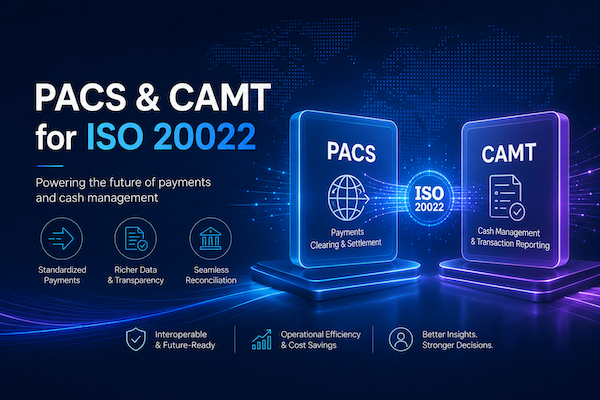
The migration to ISO 20022 represents one of the most significant changes in the financial messaging landscape, introducing a rich, data-centric standard. For professionals navigating this new environment, understanding the core message categories is essential. The two most frequently encountered categories are PACS (Payments Clearing and Settlement) and CAMT (Cash Management). While they work together to facilitate seamless transactions, they serve distinct and complementary roles in the payment lifecycle.
The ISO 20022 Naming Convention
Before exploring the differences, it is helpful to understand the logic behind the message names. ISO 20022 messages follow a structured naming convention: [Category].[Message Number].[Version].[Release] . For example, in pacs.008.001.14, "pacs" identifies the message category, "008" specifies the exact message type, and the numbers following denote the version and release. This systematic approach ensures clarity and consistency across the entire standard .
The category identifier is the key to understanding a message's purpose. The primary groups relevant to payments are:
- PAIN (Payment Initiation): Messages exchanged between a customer and their bank to initiate a payment.
- PACS (Payments Clearing and Settlement): Messages exchanged between banks for clearing and settling payments.
- CAMT (Cash Management): Messages for account reporting, statements, and exceptions .
PACS: The Language of Interbank Settlement
PACS messages are the workhorses of interbank communication, sent directly between financial institutions to facilitate the clearing and settlement of funds . They form the spine of the payment chain once a payment instruction has left the customer's domain.
When a corporate client uses a pain.001 message to initiate a payment, the bank converts this into a PACS message for transmission to the recipient's bank . These messages are exchanged within the secured environment of clearing and settlement systems, such as SWIFT, TARGET2, or Fedwire .
Common PACS messages include:
- pacs.008: Financial Institution to Customer Credit Transfer: This is the primary message used for interbank credit transfers. It carries the rich, structured data that defines modern payments. The
pacs.008replaces the legacy MT103 and MT102 messages . - pacs.009: Financial Institution Credit Transfer: Used for bank-to-bank transfers where the debtor and creditor are financial institutions, often for their own accounts. It replaces the MT202 series .
- pacs.004: Payment Return: This message is used to return a payment that was previously settled .
- pacs.002: Financial Institution to Financial Institution Payment Status Report: This message provides status updates on a payment, such as an acknowledgement, a rejection, or a cancellation .
CAMT: The Language of Account Reporting and Reconciliation
CAMT messages are the primary vehicles for cash management and reporting, enabling banks to communicate the status of accounts to their customers . They do not move funds but provide the necessary information for reconciliation, liquidity management, and exception handling.
The core purpose of CAMT is to provide transparency. They inform a customer that funds have been credited or debited, provide periodic statements, and allow for the resolution of payment errors . CAMT messages are typically sent from the account servicer (the bank) to the account owner (often a corporate client) .
Common CAMT messages include:
- camt.053: Bank to Customer Statement: This is the end-of-day statement, providing a comprehensive report of all entries booked to an account for the business day . It replaces the legacy MT940 and MT950 messages .
- camt.052: Bank to Customer Account Report: This is an intraday report, offering a near real-time view of an account's transactions and balances, providing more timely information for liquidity management .
- camt.054: Bank to Customer Debit/Credit Notification: This message is used to send an individual notification for a debit or credit entry to an account. It replaces the MT900 and MT910 confirmation messages . Notably, this message is optional for CBPR+ and must be bilaterally agreed upon between the parties . It is highly valued by corporates for enabling automated reconciliation .
- camt.056: Payment Cancellation Request: Used by a party to request the cancellation of a payment that has already been settled .
- camt.029: Payment Cancellation Request Status: Used to respond to a
camt.056, indicating whether the cancellation request has been accepted or rejected .
The Difference in Context
The critical difference is context and purpose:
- PACS messages are payment instructions that move money between banks. They are "push" messages that initiate and complete the financial transfer.
- CAMT messages are reports and notifications that provide information about money movements. They are "pull" or "informational" messages that support reconciliation, accounting, and exception management.
For example, when a bank receives a pacs.008 payment, it may send a camt.054 to the sending bank to confirm that its account has been debited . The pacs.008 instructs the funds movement, while the camt.054 reports that the debit has occurred. Similarly, a successful settlement might be reflected in a camt.053 statement .
Understanding these two categories is fundamental for treasury, payments operations, and technology teams. PACS enables the execution of payments, while CAMT provides the visibility and control necessary for effective financial management.
Popular Categories
Agile 2 Android 2 Artificial Intelligence 52 Backup Tools 2 Blockchain 2 Cloud Storage 5 Code Editors 2 Computer Languages 12 Cybersecurity 9 Data Science 18 Database 9 Digital Marketing 3 Ecommerce 4 Email Server 2 Finance 3 Google 6 HTML-CSS 2 Industries 6 Infrastructure 4 iOS 3 IoT 1 Javascript 6 Latest Technologies 45 Linux 10 LLMs 11 Machine Learning 32 Mobile 3 Msths & Stats 1 MySQL 3 Open source 1 Operating Systems 7 PHP 2 Project Management 3 Python Programming 28 SEO - AEO 5 Software Development 49 Software Testing 4 Web Server 7 Work Ethics 2