By ATS Staff - October 28th, 2026
Latest Technologies Python Programming Rust Software Development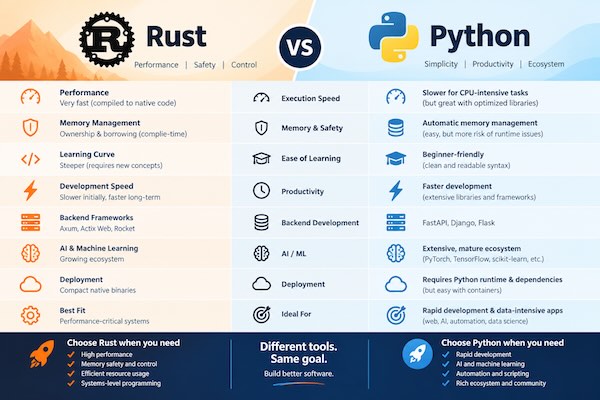
Rust and Python are two powerful programming languages, but they approach software development from very different perspectives. Python prioritizes simplicity, readability, and rapid development, while Rust focuses on performance, memory safety, and efficient resource utilization. Both languages are widely used in modern software engineering, from backend APIs and cloud infrastructure to automation, data science, and artificial intelligence. However, choosing between them requires understanding the trade-offs between execution speed, development costs, ecosystem maturity, and long-term maintenance. In this article, we compare Rust and Python across the areas that matter most to developers, startups, and businesses building modern applications.
1. Rust vs Python at a Glance
| Feature | Rust | Python |
|---|---|---|
| Primary strength | Performance and memory safety | Simplicity and productivity |
| Execution speed | Generally very fast | Generally slower for CPU-intensive code |
| Memory management | Compile-time ownership and borrowing | Automatic memory management |
| Type system | Static and strongly typed | Dynamic, with optional type hints |
| Learning curve | Steeper | Beginner-friendly |
| Development speed | Often slower initially | Usually faster for application development |
| Concurrency | Strong support for safe parallelism | Supports concurrency and parallelism with different trade-offs |
| Backend frameworks | Axum, Actix Web, Rocket | FastAPI, Django, Flask |
| AI and machine learning | Growing ecosystem | Extensive, mature ecosystem |
| Automation and scripting | Capable but more verbose | Excellent |
| Deployment | Can produce compact native executables | Often requires a Python runtime and dependencies |
| Best fit | Performance-critical systems | Rapid development and data-intensive applications |
2. Performance: Rust Has the Advantage
Performance is one of the most significant differences between Rust and Python. Rust is compiled into native machine code. Its compiler performs optimizations before the application runs, allowing developers to build efficient software with predictable resource usage. Python implementations such as CPython generally execute code through an interpreter and runtime. Although Python has improved substantially, ordinary Python code can be slower for CPU-intensive operations.Why Rust is often faster
Rust provides several advantages:- Native compilation and compiler optimizations.
- Fine-grained control over memory allocation.
- No garbage collector required for ordinary memory management.
- Efficient multithreading and parallel computation.
- Strong compile-time checks that catch many programming errors before execution.
3. Memory Management and Safety
Memory management is another area where Rust stands out.Rust: Safety enforced by the compiler
Rust uses an ownership and borrowing system to manage memory. Developers must follow rules governing ownership, references, and lifetimes. This approach helps prevent many common problems, including:- Use-after-free errors.
- Data races in safely written concurrent code.
- Invalid memory access caused by many common programming mistakes.
- Certain classes of memory leaks and resource-management errors.
Python: Automatic memory management
Python manages memory automatically, which simplifies development. Developers generally do not need to think about ownership or manually allocate and release memory. This convenience makes Python especially attractive for web applications, automation, prototypes, and data-processing workflows. However, Python applications can still suffer from memory leaks, excessive allocations, dependency vulnerabilities, and concurrency bugs. Verdict: Rust is particularly valuable when memory safety, resource control, and predictable performance are essential. Python is often preferable when development simplicity matters more than low-level control.4. Development Speed and Productivity
Performance is only one component of software engineering. Development time, debugging, testing, and maintenance also affect the total cost of a project.Python: Faster development for many applications
Python's readable syntax and extensive ecosystem allow developers to build useful applications quickly. For example, a developer can create a REST API with FastAPI, connect it to a database, validate requests, and implement authentication without writing extensive low-level infrastructure code. Python is especially effective for:- Rapid prototyping.
- Business applications.
- Web APIs and internal tools.
- Automation scripts.
- Data analysis and machine learning.
- Integrations between third-party services.
Rust: More work upfront, stronger compile-time guarantees
Rust typically requires more initial effort because developers must satisfy the borrow checker, define types carefully, and handle errors explicitly. Once a project compiles, many categories of errors have already been ruled out. This can be particularly valuable for large, performance-sensitive systems where production failures are expensive. Rust's stricter approach may reduce certain debugging and maintenance costs over time, although the benefit depends on the application and team's experience. Verdict: Python usually wins for time-to-first-release. Rust can be worth the additional investment for software that demands high performance, robust concurrency, or efficient resource usage.5. Backend Development: Rust vs Python
Both languages can power production backend services, including REST APIs, microservices, and distributed systems. The best choice depends on workload characteristics, developer expertise, and operational requirements.Building APIs with Python FastAPI
FastAPI is a modern Python framework designed for building APIs with type hints, request validation, and automatic OpenAPI documentation. Example:from fastapi import FastAPI
app = FastAPI()
@app.get("/articles/{article_id}")
def get_article(article_id: int):
return {
"article_id": article_id,
"title": "Rust vs Python"
}Building APIs with Rust Axum
Axum is a Rust web framework built around the Tokio asynchronous runtime and the Tower ecosystem. Example:use axum::{
extract::Path,
routing::get,
Json,
Router,
};
use serde::Serialize;
#[derive(Serialize)]
struct Article {
article_id: u64,
title: String,
}
async fn get_article(
Path(article_id): Path<u64>,
) -> Json<Article> {
Json(Article {
article_id,
title: "Rust vs Python".to_string(),
})
}
#[tokio::main]
async fn main() {
let app = Router::new()
.route("/articles/{article_id}", get(get_article));
let listener = tokio::net::TcpListener::bind(
"127.0.0.1:3000"
)
.await
.unwrap();
axum::serve(listener, app).await.unwrap();
}Which backend framework should you choose?
Choose FastAPI when rapid API development, Python integrations, and straightforward implementation are priorities. Choose Axum when efficient request processing, fine-grained resource control, and Rust's compile-time guarantees are important. Neither framework is automatically faster or more scalable in every real-world application. Database queries, caching, network latency, serialization, and application architecture can dominate total request time.6. Artificial Intelligence and Machine Learning
Python has a major advantage in the AI and machine learning ecosystem. Its widely used libraries and frameworks include:- PyTorch for deep learning.
- TensorFlow for machine learning.
- scikit-learn for traditional machine learning.
- NumPy and pandas for numerical computing and data analysis.
- Transformers libraries for working with pretrained models.
- FastAPI for deploying model-backed APIs.
7. Concurrency and Parallel Processing
Modern applications frequently handle thousands of simultaneous network connections, background tasks, or computational jobs. Rust and Python both support asynchronous programming, but their concurrency models have important differences.Rust concurrency
Rust supports multithreading and asynchronous execution through tools such as Tokio. Its type system helps prevent data races in safely written multithreaded code. This makes Rust attractive for:- High-throughput network services.
- Concurrent data-processing pipelines.
- Proxies and gateways.
- Distributed infrastructure.
- Systems with strict latency or memory requirements.
Python concurrency
Python supports asynchronous programming throughasyncio and frameworks such as FastAPI. It also supports threads, processes, and native extensions for parallel workloads.
In standard GIL-enabled CPython builds, the Global Interpreter Lock limits simultaneous execution of Python bytecode across threads. This can restrict CPU-bound multithreading, although multiprocessing, native libraries, and free-threaded Python builds provide alternatives.
For I/O-bound applications, Python's asynchronous capabilities can handle many concurrent connections efficiently.
Verdict: Rust is often attractive for CPU-intensive concurrency and tightly controlled resource usage. Python remains highly effective for I/O-bound services and applications that benefit from its extensive ecosystem.
8. Deployment, Cloud Costs, and Resource Usage
Cloud infrastructure costs depend on more than programming language. Request volume, database access, memory requirements, network traffic, hosting configuration, and availability targets all influence the final bill. Nevertheless, language choice can affect how much CPU and memory an application needs.Rust deployment
Rust applications can be compiled into native executables, which can simplify deployment and reduce runtime dependencies. Potential advantages include:- Lower memory usage for some workloads.
- High throughput per CPU core.
- Efficient container images when built appropriately.
- Reduced need for application-level runtime components.
- Predictable performance under heavy workloads.
Python deployment
Python applications typically require a compatible Python runtime, application dependencies, and an appropriate server configuration. Potential advantages include:- A mature ecosystem of deployment tools.
- Straightforward integration with data and AI services.
- Fast implementation of business requirements.
- Easy maintenance for teams already proficient in Python.
Which language costs less to operate?
Rust may reduce infrastructure requirements for CPU-intensive or high-throughput services. Python may reduce development and maintenance costs when features can be implemented quickly using existing libraries. A business should compare total cost of ownership, including development, testing, hosting, observability, maintenance, and the cost of production incidents. For a small application with modest traffic, developer productivity may matter more than runtime efficiency. At very high traffic volumes, even small per-request improvements may become financially significant.9. Security Considerations
Rust and Python can both be used to build secure applications, but they provide different protections. Rust's memory-safety guarantees help prevent many vulnerabilities involving invalid memory access and unsafe concurrency. Python avoids many manual memory-management concerns through its runtime, but application security still depends on implementation quality and dependency management. For either language, developers should:- Validate and sanitize untrusted input.
- Use parameterized database queries.
- Implement authentication and authorization correctly.
- Store secrets outside source code.
- Keep dependencies and runtime versions patched.
- Apply rate limiting and appropriate request-size limits.
- Configure TLS, logging, monitoring, and access controls.
- Test error handling and authorization boundaries.
10. Learning Curve and Developer Availability
Python is one of the most accessible programming languages for beginners. Its syntax is comparatively straightforward, and its large community provides extensive tutorials, libraries, and examples. Rust requires developers to understand ownership, borrowing, lifetimes, traits, and compiler diagnostics. These concepts can take time to master, especially for developers new to systems programming. However, learning Rust can provide valuable knowledge about memory, concurrency, and software architecture. When evaluating a project, businesses should consider their existing team's skills. Hiring experienced Rust developers may be more challenging in some markets than finding Python developers, although availability varies by region and specialization.11. Real-World Use Cases
The following recommendations are starting points, not strict rules.| Project | Recommended starting point | Why |
|---|---|---|
| AI-powered application | Python | Strong AI and model integration ecosystem |
| Data analytics platform | Python | Excellent data-processing libraries |
| Business REST API | Python | Fast implementation and mature frameworks |
| High-throughput API gateway | Rust | Efficient networking and resource control |
| System monitoring agent | Rust | Native execution and low-level access |
| Automation scripts | Python | Concise syntax and broad integrations |
| Embedded or systems software | Rust | Memory safety and native performance |
| Rapid MVP or startup prototype | Python | Faster experimentation |
| CPU-intensive processing service | Rust | Potentially better compute efficiency |
| Mixed AI and backend platform | Both | Combine ecosystem strengths with optimized components |
12. Can Rust and Python Work Together?
Yes. Choosing one language does not mean excluding the other. A hybrid architecture can use Python for application logic, APIs, and AI integrations while implementing selected performance-critical functions in Rust. For example, an AI-powered content management platform might use:- Python and FastAPI for authentication, article management, API endpoints, and AI service integration.
- Rust for CPU-intensive text processing, specialized parsers, or other components proven to be bottlenecks.
- PostgreSQL or MySQL for persistent data storage.
- Redis for caching and background-task coordination when needed.
- Nginx as a reverse proxy and TLS termination layer.
13. How to Decide: A Practical Benchmarking Strategy
Rather than choosing based on general performance claims, benchmark a representative version of your actual application. A useful evaluation process is:- Define the workload. Identify request volume, payload sizes, database operations, CPU requirements, and latency targets.
- Build equivalent implementations. Use comparable functionality and avoid giving one implementation an architectural advantage.
- Measure latency. Compare average response times and tail latency, such as the 95th and 99th percentiles.
- Measure throughput. Determine how many requests per second each implementation can sustain.
- Measure resources. Track CPU utilization, peak memory, and resource usage under realistic load.
- Include dependencies. Test database access, external API calls, serialization, and authentication.
- Evaluate development effort. Record implementation time, debugging time, and maintenance complexity.
- Repeat under realistic conditions. Test with the expected concurrency level and production-like deployment settings.
Conclusion
Rust and Python solve different problems exceptionally well. Rust is a strong choice for performance-sensitive services, systems programming, memory-efficient applications, and workloads where safe concurrency and predictable resource usage are important. Python is an excellent choice for rapid development, AI and machine learning, automation, data processing, and backend applications that benefit from a mature ecosystem. For most teams, the best language is not necessarily the fastest one. It is the one that meets performance and reliability requirements while keeping development and operating costs reasonable. The final recommendation: Start with Python when productivity, AI integration, and rapid iteration are the primary goals. Choose Rust when performance, resource efficiency, or systems-level control is a central requirement. For complex platforms, use both selectively and let profiling—not assumptions—determine which components need optimization.Frequently Asked Questions
Is Rust faster than Python?
Rust is generally much faster for equivalent CPU-bound code because it compiles to native machine code. The actual difference depends on the workload and implementation. Python can still achieve excellent performance by using optimized native libraries.Is Rust better than Python for backend development?
Not universally. Rust is attractive for resource-intensive, high-throughput services, while Python is excellent for rapidly developing APIs, business applications, and AI-backed services.Should beginners learn Rust or Python first?
Python is usually the easier starting point because of its readable syntax and lower initial learning curve. Rust is an excellent next step for learning systems programming, memory safety, and concurrency.Is Rust cheaper than Python to run?
It can be, especially for CPU-intensive workloads that benefit from lower resource consumption. However, total cost also includes development, maintenance, infrastructure, and team expertise.Can Rust replace Python in AI development?
Rust can handle some AI workloads and production components, but Python remains the more practical default for much of machine learning research and model development because of its extensive ecosystem.Which language should a startup choose in 2026?
For most startups building web applications, AI products, or business APIs, Python is a practical initial choice. Rust becomes particularly compelling when measured performance bottlenecks, strict resource constraints, or systems-level requirements justify the additional development effort.Popular Categories
Agile 2 Android 2 Artificial Intelligence 52 Backup Tools 2 Blockchain 2 Cloud Storage 5 Code Editors 2 Computer Languages 13 Cybersecurity 9 Data Science 19 Database 10 Digital Marketing 3 Ecommerce 4 Email Server 2 Finance 3 Google 6 HTML-CSS 2 Industries 6 Infrastructure 4 iOS 3 IoT 1 Javascript 6 Latest Technologies 46 Linux 10 LLMs 11 Machine Learning 32 Maths & Stats 1 Mobile 3 MySQL 3 Open source 1 Operating Systems 7 PHP 2 Postgres 1 Project Management 3 Python Programming 29 Rust 2 SEO - AEO 5 Software Development 51 Software Testing 4 Web Server 8 Work Ethics 2