By ATS Staff - August 11th, 2026
Artificial Intelligence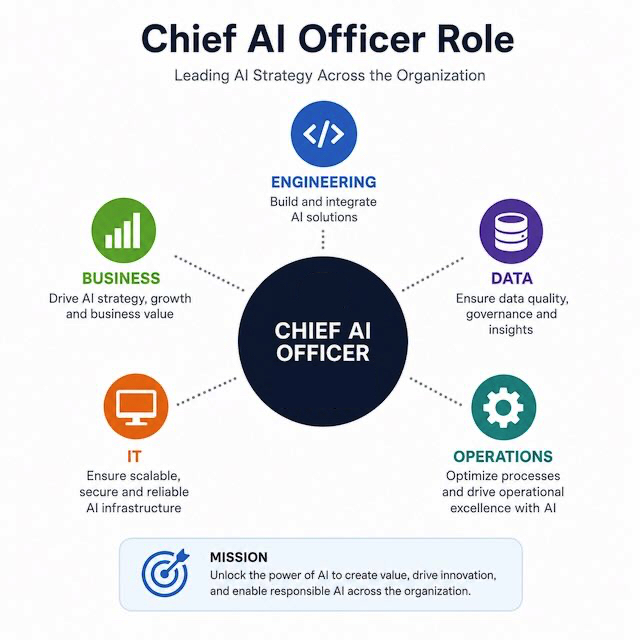
The Chief AI Officer (CAIO) role is becoming necessary, but the best person for the job may not come from traditional AI, engineering, or data-science teams. Instead, strong product strategists and innovators are the most natural candidates.
Someone must own AI outcomes
If a company wants measurable business results from AI, someone needs authority over AI strategy, priorities, implementation, and measurement. That's where the CAIO/Head of AI role comes in.
CAIO isn't purely a technical role
CAIO roles span engineering, business, data, IT, and operations—there is no single department from which every CAIO should emerge.
Product and AI are increasingly merging
Traditionally, product work involved:
- - Strategy — deciding what to build and why.
- - Management — roadmaps, priorities, releases.
- - Execution — project management, documentation, tracking, coordination.
AI is taking over much of the execution layer
AI agents can increasingly handle tasks such as documentation, ticket creation, progress tracking, communications, and other project-management activities.
Make strategic product thinking more valuable
With AI handling more of the administrative/project-management workload, humans can focus on:
- - Finding valuable opportunities
- - Inventing new products
- - Connecting technology to customer needs
- - Determining what should be built
- - Connecting AI capabilities to business strategy
The CPO and CAIO may converge
The prediction is that the Chief Product Officer and Chief AI Officer roles could eventually become nearly synonymous, because modern product innovation increasingly depends on AI.
The proposed future structure
| Layer | Primary responsibility | Likely AI involvement |
|---|---|---|
| Strategy | What to build and why | AI assists, human leads |
| Management | Roadmap, priorities, production | AI assists, human oversight |
| Execution | Tasks, documentation, tracking, coordination | Increasingly AI/agents |
Who should become CAIO?
Companies should not simply promote someone because they know how to use ChatGPT or manage AI agents.
Instead, look for people who can combine:
Product strategy + business understanding + technical knowledge + AI capabilities + innovation
It is estimated that only around 10–25% of people currently calling themselves product professionals have the strategic/inventive abilities needed for this emerging role.
The future CAIO isn't primarily the person who manages chatbots. It's the person who understands how AI can create valuable products and measurable business outcomes.
In other words, AI is reducing the importance of traditional project-management work while increasing the importance of product vision and innovation. The strongest CAIO candidates may therefore come from the small group of product leaders who can think strategically, understand technology, and turn emerging AI capabilities into real products and business value.
Popular Categories
Agile 2 Android 2 Artificial Intelligence 52 Backup Tools 2 Blockchain 2 Cloud Storage 5 Code Editors 2 Computer Languages 12 Cybersecurity 9 Data Science 18 Database 9 Digital Marketing 3 Ecommerce 4 Email Server 2 Finance 3 Google 6 HTML-CSS 2 Industries 6 Infrastructure 4 iOS 3 IoT 1 Javascript 6 Latest Technologies 45 Linux 10 LLMs 11 Machine Learning 32 Mobile 3 Msths & Stats 1 MySQL 3 Open source 1 Operating Systems 7 PHP 2 Project Management 3 Python Programming 28 SEO - AEO 5 Software Development 49 Software Testing 3 Web Server 7 Work Ethics 2