By ATS Staff - March 2nd, 2026
Artificial Intelligence Latest Technologies Software Development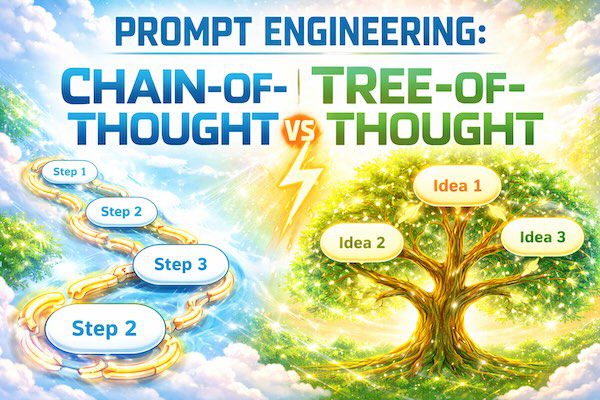
Prompt engineering is the practice of designing structured inputs that guide large language models (LLMs) to produce more accurate, logical, and useful outputs. As models like OpenAI’s GPT-4 evolved, researchers discovered that how you ask a question often matters as much as what you ask.
Among advanced prompting strategies, two reasoning-focused techniques stand out:
- Chain-of-Thought (CoT) Prompting
- Tree-of-Thought (ToT) Prompting
Both methods aim to improve reasoning performance, especially on complex tasks like math, planning, coding, and decision-making. However, they approach reasoning in fundamentally different ways.
What Is Chain-of-Thought (CoT) Prompting?
Chain-of-Thought prompting encourages the model to generate intermediate reasoning steps before producing a final answer.
Instead of asking:
What is 27 × 14?
You ask:
Solve step-by-step: What is 27 × 14?
The model then explains its reasoning process:
- 27 × 10 = 270
- 27 × 4 = 108
- 270 + 108 = 378
Final Answer: 378
Why It Works
Large language models are trained on massive amounts of text that include explanations and step-by-step reasoning. By explicitly prompting the model to “think step by step,” you activate patterns that resemble logical deduction.
Benefits of Chain-of-Thought
- Improves performance on arithmetic and logic tasks
- Increases transparency of reasoning
- Reduces careless errors
- Easy to implement (just add a reasoning instruction)
Limitations of Chain-of-Thought
- Reasoning is linear
- If an early step is wrong, the entire solution can collapse
- Doesn’t explore alternative solution paths
What Is Tree-of-Thought (ToT) Prompting?
Tree-of-Thought is a more advanced reasoning strategy inspired by decision trees and search algorithms.
Instead of following a single chain of reasoning, the model:
- Generates multiple possible reasoning paths
- Evaluates them
- Explores the most promising branches
- Selects the best final solution
This approach was formalized in research by Princeton University and Google DeepMind researchers.
How It Differs Conceptually
Chain-of-Thought = One path forward
Tree-of-Thought = Many branches explored
Think of it like:
- CoT = Walking straight down one road
- ToT = Standing at an intersection and exploring multiple routes before choosing the best one
Example Comparison
Problem:
A farmer has animals with a total of 20 heads and 56 legs. How many chickens and cows are there?
Chain-of-Thought Approach
The model might reason:
- Let chickens = x, cows = y
- x + y = 20
- 2x + 4y = 56
- Solve equations
- Result: 12 chickens and 8 cows
Single reasoning chain → final answer.
Tree-of-Thought Approach
The model may:
- Generate multiple hypotheses:
- Try more cows than chickens
- Try more chickens than cows
- Evaluate feasibility
- Prune incorrect branches
- Confirm the optimal solution
Multiple reasoning branches → evaluation → best result.
Structural Differences
| Feature | Chain-of-Thought | Tree-of-Thought |
|---|---|---|
| Reasoning style | Linear | Branching |
| Error recovery | Weak | Stronger |
| Exploration | Single path | Multiple paths |
| Complexity | Simple to implement | More complex |
| Best for | Math, logic, step problems | Planning, strategy, puzzles |
When to Use Chain-of-Thought
Use CoT when:
- The problem has a clear step-by-step solution
- The reasoning path is straightforward
- You want transparency
- Speed is important
Examples:
- Math calculations
- Coding logic
- Basic logical reasoning
When to Use Tree-of-Thought
Use ToT when:
- The problem requires exploration
- There are multiple possible solutions
- Strategy and evaluation are needed
- You want higher reliability
Examples:
- Game strategy
- Business decision analysis
- Complex planning
- Brainstorming multiple approaches
Implementation Differences in Practice
Simple CoT Prompt Template
Solve the problem step-by-step and explain your reasoning clearly before giving the final answer.
Simple ToT Prompt Template
Generate multiple possible reasoning paths.
Evaluate each path.
Prune weaker options.
Select the best final answer.
Explain your decision.
ToT often requires more structured control, sometimes through external orchestration code rather than a single prompt.
Performance Insights
Research shows:
- CoT significantly improves reasoning accuracy compared to direct answers.
- ToT can outperform CoT on complex search problems.
- ToT requires more computation and careful design.
In production systems, ToT is often implemented with controlled iterative prompting rather than a single instruction.
Strengths and Weaknesses Summary
Chain-of-Thought Strengths
- Simple
- Fast
- Transparent
- Highly effective for structured problems
Chain-of-Thought Weaknesses
- Fragile if reasoning goes wrong
- No alternative exploration
Tree-of-Thought Strengths
- More robust
- Better for complex reasoning
- Can self-correct via evaluation
Tree-of-Thought Weaknesses
- Slower
- Requires more tokens
- More complex to implement
The Bigger Picture
Both techniques reflect a broader truth in prompt engineering:
The quality of reasoning depends on how reasoning is structured.
Chain-of-Thought unlocked a major leap in LLM reasoning performance. Tree-of-Thought extends this by adding search and evaluation mechanisms.
As models continue to improve, hybrid approaches—combining linear reasoning with structured branching—are becoming more common in advanced AI systems.
Final Thoughts
Chain-of-Thought is like thinking carefully.
Tree-of-Thought is like thinking strategically.
If you're building AI applications—whether educational tools, planning systems, or coding assistants—understanding when to use each technique can significantly improve output quality.
Prompt engineering is not just about better prompts.
It’s about designing better thinking.
Popular Categories
Agile 2 Android 2 Artificial Intelligence 52 Backup Tools 2 Blockchain 2 Cloud Storage 5 Code Editors 2 Computer Languages 12 Cybersecurity 9 Data Science 18 Database 9 Digital Marketing 3 Ecommerce 4 Email Server 2 Finance 3 Google 6 HTML-CSS 2 Industries 6 Infrastructure 4 iOS 3 IoT 1 Javascript 6 Latest Technologies 45 Linux 10 LLMs 11 Machine Learning 32 Mobile 3 Msths & Stats 1 MySQL 3 Open source 1 Operating Systems 7 PHP 2 Project Management 3 Python Programming 28 SEO - AEO 5 Software Development 49 Software Testing 4 Web Server 7 Work Ethics 2