By ATS Staff - March 2nd, 2026
Data Science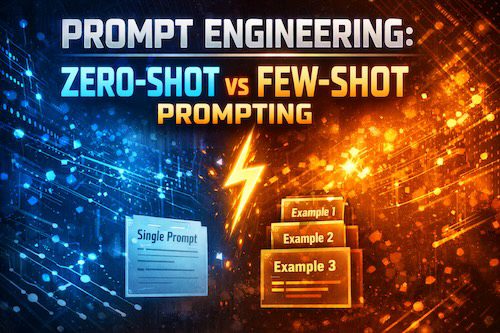
Artificial Intelligence systems powered by large language models (LLMs) have transformed how we write, code, analyze data, and automate tasks. However, the quality of their output depends heavily on how we communicate with them. This practice of crafting effective instructions is known as prompt engineering.
In this article, we’ll explore what prompt engineering is, and examine the difference between zero-shot and few-shot prompting, two fundamental techniques used to guide AI systems.
What Is Prompt Engineering?
Prompt engineering is the process of designing and refining inputs (prompts) to obtain accurate, relevant, and high-quality responses from AI models.
A prompt can include:
- A clear instruction
- Context or background information
- Constraints (tone, format, length)
- Examples (optional)
- Desired output structure
For example:
“Write a professional email to a client explaining a 2-day delay in project delivery. Keep it concise and polite.”
This is a basic prompt. A well-engineered version might include more context:
“Write a professional email to a client explaining a 2-day delay in project delivery due to unexpected server issues. Maintain a polite tone, take responsibility, and reassure them that the issue is resolved. Keep it under 150 words.”
The second prompt is clearer and more likely to produce a useful result.
Why Prompt Engineering Matters
AI models do not “think” like humans. They predict the most probable next words based on patterns learned during training. Small changes in wording can significantly impact the output.
Effective prompt engineering helps:
- Improve accuracy
- Reduce ambiguity
- Control tone and format
- Increase consistency
- Save time on revisions
Zero-Shot Prompting
What Is Zero-Shot Prompting?
Zero-shot prompting means giving the model a task without providing any examples. You simply describe what you want, and the model attempts to perform the task based on its prior training.
Example (Zero-Shot)
“Classify the sentiment of this sentence as Positive, Negative, or Neutral:
‘The service was quick and the staff was friendly.’”
The model responds:
Positive
No examples were provided — the model relies entirely on its general understanding.
Advantages of Zero-Shot Prompting
- Simple and fast
- Requires minimal input
- Works well for common tasks
- Efficient for quick experimentation
Limitations
- May produce inconsistent results
- Less reliable for complex or specialized tasks
- More sensitive to ambiguous instructions
Zero-shot prompting is ideal when the task is straightforward and well-defined.
Few-Shot Prompting
What Is Few-Shot Prompting?
Few-shot prompting involves providing a small number of examples before asking the model to perform the task. These examples help the model understand the pattern, structure, and expectations more clearly.
Example (Few-Shot)
Classify the sentiment as Positive, Negative, or Neutral.
Example 1:
“I love this product.” → PositiveExample 2:
“This is the worst experience I’ve had.” → NegativeNow classify:
“The service was quick and the staff was friendly.”
The model is more likely to produce:
Positive
The examples guide the model’s response style and reasoning.
Advantages of Few-Shot Prompting
- Higher accuracy
- More consistent formatting
- Better performance on complex tasks
- Improved control over output style
Limitations
- Requires more effort to design
- Uses more input space
- Can become lengthy
Few-shot prompting is especially useful in structured tasks like:
- Data classification
- Information extraction
- Translation with specific formatting
- Code generation patterns
Zero-Shot vs Few-Shot: Key Differences
| Feature | Zero-Shot | Few-Shot |
|---|---|---|
| Examples Provided | No | Yes (a few) |
| Ease of Setup | Very Easy | Moderate |
| Accuracy | Moderate | Higher |
| Best For | Simple tasks | Complex or structured tasks |
| Control Over Output | Limited | Greater |
When to Use Each Approach
Use Zero-Shot When:
- The task is general and common
- You need quick results
- The model already understands the concept well
- You are experimenting
Use Few-Shot When:
- The output format must follow a strict pattern
- The task is domain-specific
- Precision is important
- You want consistent responses across multiple prompts
Best Practices in Prompt Engineering
Regardless of the technique, follow these guidelines:
- Be specific and clear
- Define output format explicitly
- Provide context when necessary
- Use constraints (length, tone, structure)
- Test and iterate
Example improvement:
Instead of:
“Summarize this article.”
Use:
“Summarize this article in 5 bullet points, focusing on technical insights. Keep each bullet under 20 words.”
Conclusion
Prompt engineering is a powerful skill that enhances how we interact with AI systems. Understanding the difference between zero-shot and few-shot prompting allows users to choose the right strategy depending on the task.
- Zero-shot prompting is efficient and simple.
- Few-shot prompting offers greater precision and control.
As AI tools become more integrated into software platforms, data science workflows, and content systems, mastering prompt engineering will become an essential skill for developers, analysts, and content creators alike.
Whether you are building an AI-powered feature or simply trying to get better responses from a language model, choosing the right prompting technique can make all the difference.
Popular Categories
Agile 2 Android 2 Artificial Intelligence 52 Backup Tools 2 Blockchain 2 Cloud Storage 5 Code Editors 2 Computer Languages 12 Cybersecurity 9 Data Science 18 Database 9 Digital Marketing 3 Ecommerce 4 Email Server 2 Finance 3 Google 6 HTML-CSS 2 Industries 6 Infrastructure 4 iOS 3 IoT 1 Javascript 6 Latest Technologies 45 Linux 10 LLMs 11 Machine Learning 32 Mobile 3 Msths & Stats 1 MySQL 3 Open source 1 Operating Systems 7 PHP 2 Project Management 3 Python Programming 28 SEO - AEO 5 Software Development 49 Software Testing 4 Web Server 7 Work Ethics 2