By ATS Staff - February 18th, 2026
Python Programming Software Development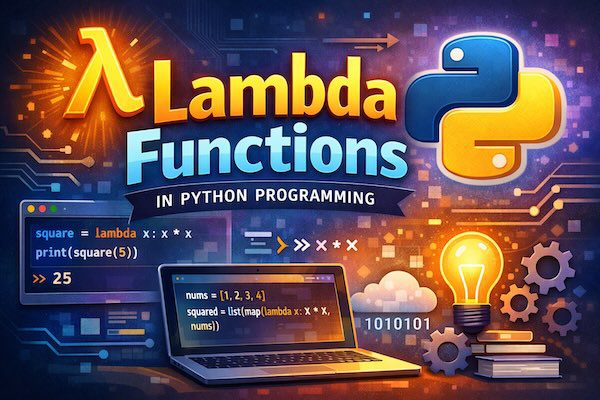
In Python, lambda functions are small, anonymous functions defined in a single line. They are commonly used for short, simple operations where defining a full function using def would be unnecessary.
Lambda functions make your code more concise and are especially useful when working with higher-order functions like map(), filter(), and sorted().
1. What Is a Lambda Function?
A lambda function is an anonymous function — meaning it doesn’t have a name (unless you assign it to a variable).
Syntax:
lambda arguments: expression
lambda→ keyword to define the functionarguments→ input parametersexpression→ a single expression that is evaluated and returned
Unlike normal functions:
- It contains only one expression
- It automatically returns the result
- It cannot contain multiple statements
2. Basic Example
Using a Normal Function:
def add(x, y):
    return x + y
Using a Lambda Function:
add = lambda x, y: x + y
Both work the same way:
print(add(5, 3)) # Output: 8
3. Why Use Lambda Functions?
Lambda functions are useful when:
- You need a short function temporarily
- You want cleaner and more readable inline code
- You're working with functions that accept other functions as arguments
4. Lambda with map()
The map() function applies a function to every item in an iterable.
Example:
numbers = [1, 2, 3, 4]

squared = list(map(lambda x: x**2, numbers))
print(squared)
Output:
[1, 4, 9, 16]
5. Lambda with filter()
The filter() function filters elements based on a condition.
numbers = [1, 2, 3, 4, 5, 6]

even = list(filter(lambda x: x % 2 == 0, numbers))
print(even)
Output:
[2, 4, 6]
6. Lambda with sorted()
Lambda functions are commonly used as a key function in sorting.
students = [
    ("Ali", 85),
    ("Sara", 92),
    ("John", 78)
]

sorted_students = sorted(students, key=lambda student: student[1])
print(sorted_students)
This sorts students by marks.
7. Multiple Arguments
Lambda functions can take multiple arguments:
multiply = lambda a, b, c: a * b * c
print(multiply(2, 3, 4))  # Output: 24
8. Lambda Inside Another Function
You can return a lambda function from another function:
def power(n):
    return lambda x: x ** n

square = power(2)
cube = power(3)

print(square(5))  # 25
print(cube(5))    # 125
This demonstrates closures in Python.
9. Limitations of Lambda Functions
Lambda functions:
- Can only contain a single expression
- Cannot include multiple statements
- Cannot contain complex logic
- Are less readable if overused
For complex functionality, always use a normal def function.
10. When NOT to Use Lambda
Avoid lambda functions when:
- The function is large or complex
- You need multiple lines of logic
- Readability is reduced
- You want proper documentation and naming
Conclusion
Lambda functions in Python provide a quick and efficient way to define small anonymous functions. They are powerful when used correctly — especially with functional programming tools like map(), filter(), and sorted().
However, clarity should always come first. Use lambda functions for simplicity, not complexity.
Popular Categories
Agile 2 Android 2 Artificial Intelligence 51 Blockchain 2 Cloud Storage 3 Code Editors 2 Computer Languages 12 Cybersecurity 8 Data Science 16 Database 7 Digital Marketing 3 Ecommerce 3 Email Server 2 Finance 2 Google 6 HTML-CSS 2 Industries 6 Infrastructure 3 iOS 3 IoT 1 Javascript 5 Latest Technologies 45 Linux 5 LLMs 11 Machine Learning 32 Mobile 3 MySQL 3 Operating Systems 3 PHP 2 Project Management 3 Python Programming 28 SEO - AEO 5 Software Development 49 Software Testing 3 Web Server 7 Work Ethics 2