By ATS Staff - February 18th, 2026
Latest Technologies Python Programming Software Development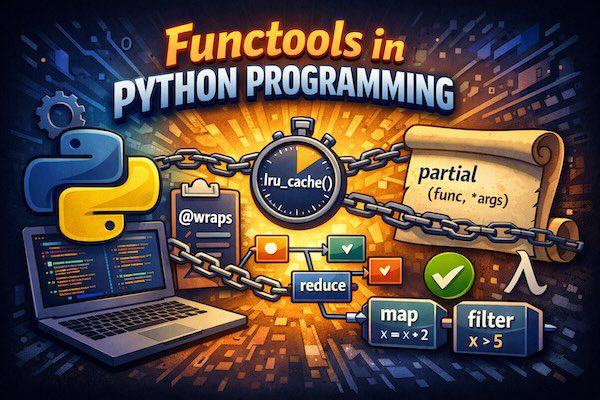
In Python, writing clean, reusable, and efficient code is a priority. The built-in functools module provides powerful tools that help you work with higher-order functions—functions that act on or return other functions. It enhances functional programming patterns and improves readability, performance, and maintainability.
This article explores the most important features of the functools module and how to use them effectively.
What is functools?
The functools module is part of Python’s standard library. It provides higher-order functions that:
- Modify or enhance other functions
- Cache results
- Reduce iterable data
- Help with decorators
- Support functional programming patterns
To use it:
import functools
1. functools.partial
partial() allows you to fix (or “pre-fill”) some portion of a function’s arguments and generate a new function.
Example:
from functools import partialdef multiply(x, y):
    return x * ydouble = partial(multiply, 2)print(double(5))  # Output: 10
Here, double() always multiplies a number by 2.
When to Use:
- Creating specialized versions of general functions
- Simplifying repeated calls with fixed parameters
- Cleaner callbacks in frameworks
2. functools.reduce
reduce() applies a function cumulatively to items of an iterable, reducing it to a single value.
Example:
from functools import reducenumbers = [1, 2, 3, 4]result = reduce(lambda x, y: x + y, numbers)print(result) # Output: 10
How it Works:
It computes:
(((1 + 2) + 3) + 4)
When to Use:
- Aggregation operations
- Custom cumulative computations
- Functional-style programming
Note: Often replaced by built-in functions like
sum()when possible.
3. functools.lru_cache
lru_cache() is one of the most powerful decorators in functools. It caches results of function calls to improve performance.
Example:
from functools import lru_cache@lru_cache(maxsize=128)
def fibonacci(n):
    if n < 2:
        return n
    return fibonacci(n-1) + fibonacci(n-2)print(fibonacci(40))
Why It’s Powerful:
Without caching, Fibonacci recursion is slow. With lru_cache, repeated calls reuse stored results.
When to Use:
- Expensive computations
- Recursive functions
- Repeated calls with same arguments
- API result caching
4. functools.wraps
When creating decorators, metadata like function name and docstring can be lost. wraps() preserves them.
Example:
from functools import wrapsdef my_decorator(func):
    @wraps(func)
    def wrapper(*args, **kwargs):
        print("Before function call")
        return func(*args, **kwargs)
    return wrapper@my_decorator
def greet():
    """Greets the user"""
    print("Hello!")print(greet.__name__)  # greet (not wrapper)
Why It Matters:
Without wraps, debugging and documentation tools may show incorrect function details.
5. functools.cmp_to_key
Converts old-style comparison functions into key functions for sorting.
Example:
from functools import cmp_to_keydef compare(a, b):
    return a - bnumbers = [4, 1, 3, 2]
numbers.sort(key=cmp_to_key(compare))print(numbers)
When to Use:
- Custom sorting logic
- Migrating Python 2 comparison functions to Python 3
6. functools.cached_property
Available in Python 3.8+, cached_property works like a property but caches the result after the first call.
Example:
from functools import cached_propertyclass Data:
    @cached_property
    def expensive_calculation(self):
        print("Computing...")
        return sum(range(1000000))obj = Data()
print(obj.expensive_calculation)
print(obj.expensive_calculation)  # Cached, no recomputation
When to Use:
- Expensive object attributes
- Lazy evaluation
- Computed properties
Why functools is Important
Using functools helps you:
- Write cleaner decorators
- Improve performance with caching
- Reduce repetitive code
- Apply functional programming concepts
- Build scalable systems
In modern frameworks like Django, FastAPI, and Flask, functools is frequently used behind the scenes for decorators, caching, and middleware logic.
Practical Use Cases
- API response caching
- Recursive algorithms optimization
- Custom sorting logic
- Cleaner callback definitions
- Middleware and decorator development
Conclusion
The functools module is a powerful yet often underutilized part of Python’s standard library. Whether you're building APIs, optimizing algorithms, or writing clean decorators, mastering functools can significantly improve your code quality and performance.
If you're developing larger systems or frameworks, especially in backend projects, understanding functools is essential for writing efficient and maintainable Python code.
Popular Categories
Agile 2 Android 2 Artificial Intelligence 51 Blockchain 2 Cloud Storage 3 Code Editors 2 Computer Languages 12 Cybersecurity 8 Data Science 16 Database 7 Digital Marketing 3 Ecommerce 3 Email Server 2 Finance 2 Google 6 HTML-CSS 2 Industries 6 Infrastructure 3 iOS 3 IoT 1 Javascript 5 Latest Technologies 45 Linux 5 LLMs 11 Machine Learning 32 Mobile 3 MySQL 3 Operating Systems 3 PHP 2 Project Management 3 Python Programming 28 SEO - AEO 5 Software Development 49 Software Testing 3 Web Server 7 Work Ethics 2